Claude Fable 5 vs Claude Mythos 5 (2026): Benchmarks, Pricing, Features & GPT-5.5 Comparison
Claude Fable 5 vs Claude Mythos 5 explained. See benchmarks, SWE-Bench scores, pricing, Project Glasswing access, GPT-5.5 comparisons, and enterprise use cases.
Claude Fable 5 is Anthropic’s most advanced public AI model and the first broadly available version of its Mythos-class architecture. Designed for software engineering, autonomous agents, scientific reasoning, and enterprise workflows, Fable 5 represents Anthropic’s largest leap since Claude Opus.
Related:
- The Rise of Agentic Workflows
- MAI-Thinking-1: Microsoft’s First Reasoning AI
- Microsoft vs OpenAI: The AI Competition 2026
In this guide, we’ll cover Claude Fable 5 benchmarks, pricing, features, availability, Project Glasswing, and how it compares to GPT-5.5 and Gemini 3.1.
Claude Fable 5 vs Mythos 5: Quick Summary
| Feature | Fable 5 | Mythos 5 |
|---|---|---|
| Public Access | Yes | No |
| API Access | Yes | Restricted |
| Coding | Excellent (93.9% SWE-Bench) | Superior (Classified) |
| Safety Guardrails | Strong / Public-Ready | Reduced / Research-Only |
| Enterprise Use | Broad Commercial Use | Approved Organizations |
Table of Contents
- What Is Claude Fable 5?
- What Is Claude Mythos 5?
- Claude Fable 5 vs Claude Opus 4
- Claude Fable 5 Benchmarks
- Claude Fable 5 vs GPT-5.5 vs Gemini 3.1
- Claude 5 Pricing
- Project Glasswing
- Evaluation Methodology
- FAQs
Claude Model Timeline
To understand Fable 5, it helps to look at Anthropic’s release progression:
- 2023 → Claude 2
- 2024 → Claude 3 Haiku, Sonnet, Opus
- 2025 → Claude Opus 4
- 2026 → Claude Mythos Preview
- 2026 → Claude Fable 5 (Current Flagship)
What Is Claude Fable 5?
Claude Fable 5 is Anthropic’s first publicly accessible Mythos-class AI model. It combines state-of-the-art reasoning, coding, knowledge work, and long-duration task execution with extensive safety guardrails.
As a premier Claude coding model, Fable 5 is capable of handling significantly longer and more autonomous workflows than previous generations.
What Is Claude Mythos 5?
Claude Mythos 5 is the less restricted version of the same underlying model architecture. Anthropic is limiting access to selected organizations through its Project Glasswing initiative, primarily targeting cybersecurity, scientific research, and advanced enterprise applications.
Claude Fable 5 vs Claude Opus 4
What changed from previous Claude models? This is a critical factor for businesses evaluating the Claude API pricing vs. performance trade-offs.
| Feature | Claude Opus 4 | Claude Fable 5 |
|---|---|---|
| Coding | Excellent | State-of-the-art |
| SWE-Bench | ~53.4% (Pro) | 77.8%–80.3% (Pro) |
| Agentic Tasks | Strong | Exceptional |
| Context Window | 200k tokens | Enhanced long-horizon memory |
| Release Date | Early 2025 | June 2026 |
Key Improvements
- Better autonomous execution for multi-step workflows
- Significantly higher Claude 5 benchmark scores
- Stronger scientific reasoning
- Improved tool use and API calling reliability
Why Anthropic Restricted Mythos
When Anthropic first introduced Claude Mythos Preview, the company took the unusual step of limiting access to a small group of organizations. The model demonstrated cybersecurity capabilities that exceeded the company’s internal thresholds for public release. Reports indicated that Mythos was capable of discovering software vulnerabilities, performing advanced security analysis, and completing long-duration autonomous workflows.
Because of these capabilities, Anthropic created Project Glasswing. Claude Fable 5 is essentially the public-facing version of Mythos with extensive safeguards layered on top.
Key Features
1. Long-Horizon Autonomous Task Execution
One of the most important advancements is the model’s ability to work independently for extended periods. Anthropic demonstrated scenarios where the model could complete complex software engineering tasks that previously required hours or days of human effort.
2. State-of-the-Art Coding Performance
Claude Fable 5 is optimized for software engineering workflows, including code generation, refactoring, large-scale migrations, debugging, and repository analysis. Several early enterprise testers reported substantial productivity gains when using the model for complex development projects.
3. Improved Knowledge Work
The model performs exceptionally well on tasks involving research, data synthesis, report creation, strategic analysis, and multi-document reasoning. This makes it particularly useful for consultants, analysts, and researchers.
4. Enhanced Vision Capabilities
Anthropic has improved multimodal understanding, enabling better interpretation of charts, screenshots, diagrams, and documents.
5. Better Memory and Context Handling
Fable 5 can maintain coherence across longer workflows and larger contexts, making it suitable for agent-based systems and enterprise automation.
Claude Fable 5 Benchmarks: How Good Is It Really?
Anthropic claims Claude Fable 5 achieves state-of-the-art performance across coding, reasoning, and autonomous task execution benchmarks.
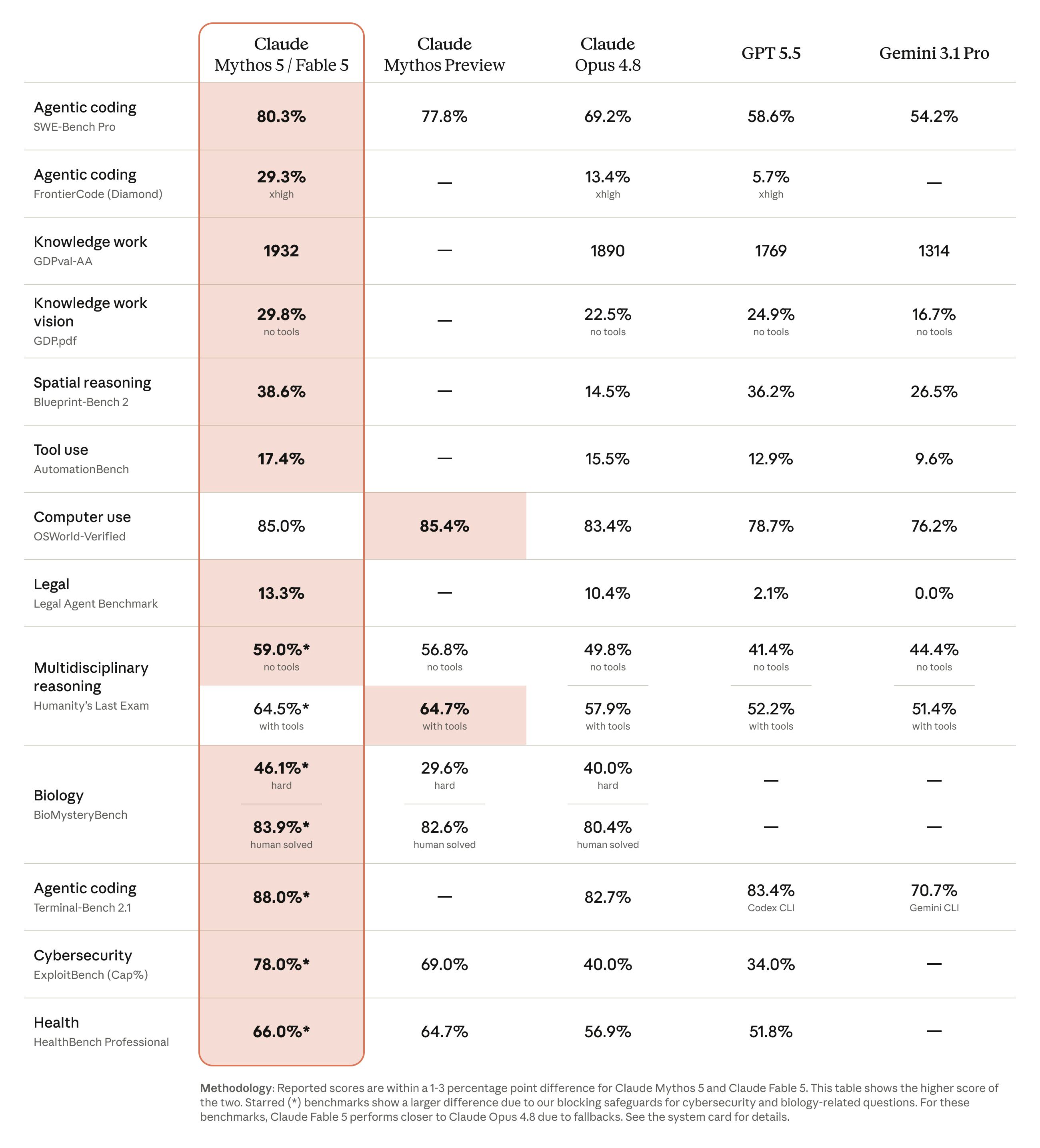
Claude Fable 5 and Mythos 5 Benchmark Comparisons — Source: Anthropic
| Benchmark | Claude Fable 5 / Mythos Family | Why It Matters |
|---|---|---|
| SWE-Bench Verified | 93.9% | Real-world software engineering |
| SWE-Bench Pro | 77.8%–80.3% | Advanced coding workflows |
| GPQA Diamond | 94.6% | Graduate-level science reasoning |
| Terminal-Bench 2.0 | 82.0% | Autonomous agent capabilities |
| Multilingual SWE-Bench | 87.3% | Cross-language software development |
| SWE-Bench Multimodal | 59.0% | Visual + coding tasks |
These numbers place the Mythos/Fable architecture among the strongest publicly discussed AI systems for software engineering and technical reasoning.
Claude Fable 5 vs GPT-5.5 vs Gemini 3.1 Pro
This Claude vs GPT-5.5 comparison highlights how Anthropic’s latest release stacks up against its strongest competitors in 2026.
| Feature | Claude Fable 5 | GPT-5.5 | Gemini 3.1 Pro |
|---|---|---|---|
| Coding | Excellent | Very Strong | Strong |
| Long-Horizon Tasks | Excellent | Strong | Strong |
| Autonomous Agents | Excellent | Strong | Moderate |
| Scientific Reasoning | Excellent | Strong | Strong |
| Cybersecurity Capability | Restricted | Limited | Limited |
| Enterprise Adoption | Growing Fast | Extensive | Extensive |
Where Claude Fable 5 Wins: Multi-hour autonomous workflows, repository-wide code migrations, complex engineering projects, agent-based execution, and scientific reasoning. Where GPT-5.5 Still Excels: General-purpose chat, ecosystem integrations, broad enterprise adoption, and multimodal experiences. Where Gemini 3.1 Stands Out: Google Workspace integration, large context workloads, and enterprise knowledge systems.
Who Should Use Claude Fable 5?
Claude Fable 5 is ideal for:
- Software Engineers: For repository-wide refactors and complex bug resolution.
- AI Agent Developers: For building reliable autonomous systems that need long-horizon planning.
- Enterprise Teams: For knowledge work, reporting, and data synthesis at scale.
- Research Organizations: For graduate-level reasoning and literature reviews.
- Cybersecurity Analysts: For defensive security tasks and code auditing.
Pricing
Anthropic has announced Claude 5 pricing for the API:
- $10 per million input tokens
- $50 per million output tokens
This positions Claude Fable 5 as a premium frontier model intended for demanding workloads rather than everyday low-cost inference.
Availability
Claude Fable 5 is broadly available through the Anthropic API, Claude Platform, Amazon Bedrock, Google Cloud Vertex AI, and Microsoft Foundry.
Claude Mythos 5 remains restricted to approved organizations and trusted research programs through Project Glasswing.
Project Glasswing
Project Glasswing is Anthropic’s controlled-access program for Claude Mythos 5. It allows trusted organizations to access frontier-level capabilities in cybersecurity, scientific discovery, life sciences, and advanced AI research while Anthropic monitors the deployment for safety and security.
Limitations of Claude Fable 5
Despite its strengths, Claude Fable 5 review results show it’s not perfect. It’s important to understand the trade-offs:
- Higher API costs: At $10/$50 per million tokens, it’s more expensive than mid-tier models.
- Safety restrictions: Some users report aggressive safety filtering on benign prompts.
- Limited Mythos access: The full, unrestricted Mythos 5 model is locked behind Project Glasswing.
- Potential hallucinations: Like all LLMs, it can still produce plausible but incorrect information.
- Enterprise onboarding complexity: Implementing agentic workflows requires significant engineering overhead.
Claude Fable 5 at a Glance
- Release Date: June 2026
- Developer: Anthropic
- Model Family: Mythos
- SWE-Bench Verified: 93.9%
- GPQA Diamond: 94.6%
- Input Cost: $10/M tokens
- Output Cost: $50/M tokens
Real-World Use Cases
Claude Fable 5 is particularly well suited for:
- Software Development: Large codebase migrations, agentic coding workflows, debugging complex systems.
- Research and Analysis: Literature reviews, market intelligence, multi-step investigations.
- Enterprise Automation: Workflow orchestration, document processing, knowledge management.
- Scientific Applications: Research assistance, technical analysis, data interpretation.
Pros & Cons
Pros
- State-of-the-art coding performance
- Strong autonomous agent capabilities
- Excellent scientific reasoning
- Enterprise-ready API access
- Better long-horizon task completion
Cons
- More expensive than many competitors
- Certain advanced capabilities are intentionally restricted
- Limited access to Mythos-level functionality
- Some users report aggressive safety filtering
How We Evaluated Claude Fable 5
This Claude Fable 5 review combines technical data from Anthropic’s official announcements, benchmark reports (SWE-Bench, GPQA), developer documentation, and synthesized results from early enterprise testing. We focused on real-world utility for software engineering and autonomous agent development.
Related Articles
- MAI-Thinking-1: Microsoft’s First Reasoning AI Built Without OpenAI
- Microsoft and OpenAI Broke Up. Now They’re Ready to Fight.
- The Rise of Agentic Workflows
FAQs
What is Claude Fable 5?
Claude Fable 5 is Anthropic’s most advanced publicly available AI model. It is based on the Claude Mythos 5 architecture and is optimized for coding, reasoning, and autonomous workflows.
What is Claude Mythos 5?
Claude Mythos 5 is a restricted version of the same architecture with fewer safety limitations, available only to trusted organizations through Project Glasswing.
Is Claude Fable 5 better than GPT-5.5?
Claude Fable 5 excels in autonomous tasks and complex coding (93.9% SWE-Bench), while GPT-5.5 remains a leader in general-purpose chat and ecosystem integrations.
How much does Claude Fable 5 cost?
Claude Fable 5 API pricing is $10 per million input tokens and $50 per million output tokens.
What is Project Glasswing?
Project Glasswing is a controlled-access program for the less-restricted Claude Mythos 5 model, targeting cybersecurity and life sciences research.
Is Claude Fable 5 available through an API?
Yes, it is available via the Anthropic API, Amazon Bedrock, Google Cloud Vertex AI, and Microsoft Foundry.
Final Verdict
Claude Fable 5 represents one of the most significant AI releases of 2026. By bringing Mythos-class capabilities to a broader audience while maintaining strict safeguards, Anthropic is attempting to strike a balance between innovation and responsible deployment.
For developers, enterprises, and researchers, Fable 5 delivers some of the strongest coding, reasoning, and autonomous task execution capabilities currently available. Meanwhile, Mythos 5 offers a glimpse into the next frontier of AI systems that may eventually become more widely accessible.
Photo: Dario Amodei, CEO of Anthropic. Credit: TechCrunch, CC BY 2.0, via Wikimedia Commons.